
If you’re worried that retirement might feel unstructured, empty, or strangely disorienting, this will help.
One of the biggest surprises I’ve learned since retiring is that freedom, on its own, is not enough. When the calendar suddenly clears, when there are no deadlines, no performance reviews, no meetings anchoring the week, something subtle happens. Days blur. Time stretches. And without meaning, even freedom can start to feel uncomfortable.
That is why I rate my days.
Not obsessively. Not with spreadsheets or scores that need optimizing. But intentionally. Because what gets measured gets done. And more importantly, what gets reflected on gets understood.
Retirement Is Not a Switch. It’s a Skill.
We spend decades learning how to work.
We learn how to show up on time.
How to manage expectations.
How to deliver outcomes.
How to be productive.
But no one teaches us how to retire.
We assume retirement will automatically feel good simply because work has stopped. Yet many retirees constantly struggle during the transition. Not financially, but emotionally and structurally. I’ve had countless conversations with people who tell me the same thing:
“I finally have time, but I don’t know what to do with it.”
“I feel busy, but not fulfilled.”
“I thought retirement would feel different.”
The uncomfortable truth is this. Retirement is not the absence of work. It is the presence of choice. And choice, without structure, can be surprisingly heavy. That is where measurement comes in. Not to constrain freedom, but to support it.
The 4-Block Day: A Simple Way to Design a Good Day
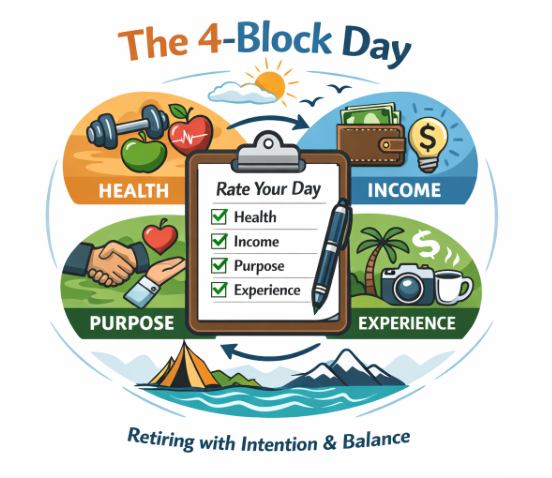
The framework I use is something I call the 4-Block Day. It aligns closely with how I think about retirement using my broader HIPE philosophy. The daily application is simple. Every day is viewed through four lenses:
Health – Did I invest in my body and energy?
Income – Did I contribute to financial sustainability?
Purpose – Did I connect, serve, or do something meaningful?
Experience – Did I enjoy life, presence, or novelty?
At the end of the day, I ask myself one simple question: “How did today do across these four blocks?” No guilt. No perfectionism. Just awareness. Some days are strong in one or two blocks and light in others. That’s normal. What matters is balance over time, not daily symmetry.
The 4-Block Retirement Day
A Simple Framework To a Meaningful, Energising, and Financially Sustainable Retired Life
Why I Started Rating My Days
I didn’t begin this practice because I was unhappy. I began because I was aware.
Aware that during the early transition into retirement, habits are fragile.
Aware that without intention, days fill themselves with noise.
Aware that I didn’t want to drift into a life that looked full but felt hollow.
In my working years, the structure was imposed externally. In retirement, structure must be chosen internally. Rating my days became a way to gently anchor myself. Not to judge my worth. But to notice patterns. And patterns tell the truth faster than emotions do.
What Gets Measured Gets Done (Even in Retirement)
This phrase is often used in business contexts, but it applies beautifully to life design. When I started reflecting on my days, something interesting happened. Experience became a conscious block.
- I moved more consistently, because I noticed when Health slipped.
- I wrote more regularly, because Income became visible, not assumed.
- I reached out to friends more often, because Purpose does not happen by accident.
- I savored moments instead of rushing through them, because
Measurement didn’t make my life rigid. It made it deliberate. And that is the difference between being busy and being fulfilled.
The Early Transition Phase Matters More Than You Think
You do not need to measure your days forever. But in the initial transition into retirement, measurement is incredibly helpful. Why? Because identity is shifting. You are no longer defined by your role, your title, or your calendar. You are redefining who you are without external validation. This takes time. And during that time, gentle structure prevents drift. Think of it like learning to swim in open water. You don’t jump in and throw away the float immediately. You use support until confidence builds. Then you let go naturally. Rating my days was my float.
What a “Good” Day Looks Like (And Doesn’t)
Here’s something important. A good day is not a productive day by corporate standards. Some of my best-rated days look quiet.
A walk at the gym.
Writing a few thoughtful paragraphs.
Coffee with a friend. A simple conversation with no agenda.
Nothing Instagram-worthy.
Nothing that would impress my former boss.
But deeply satisfying.
Conversely, some days look busy but rate poorly. Lots of activity with little or no alignment. Rating my day helps me see the difference.
This Is Not About Control. It’s About Alignment.
I want to be very clear. This practice is not about squeezing more output from retirement. It is not about optimizing joy. And it is definitely not about turning life into a KPI dashboard. It is about alignment. Alignment between how I say I want to live and how I actually spend my days. Without reflection, intention remains theoretical. With reflection, it becomes lived experience.
How You Can Start (Without Overthinking It)
If you’re approaching retirement, or newly retired, here’s a simple way to begin. At the end of each day, ask yourself:
Did I do something for my health?
Did I contribute something toward income or sustainability?
Did I experience some sense of purpose or connection?
Did I enjoy one moment fully?
You can rate each block mentally. Or jot down a word or two. That’s it. No apps required. No templates needed. Just honesty. Over time, you’ll start to see patterns. And those patterns will guide better decisions than any retirement calculator ever could.
Learning How to Retire Is the Real Work
We prepare obsessively for retirement financially.
We calculate withdrawal rates.
We debate dividend strategies.
We model worst-case scenarios.
All of that matters.
But very few people prepare for the lived experience of retirement ….
The emotional rhythm.
The daily shape.
The quiet moments when no one is watching.
This is why I rate my days. Not because I lack freedom. But because I respect it.
Final Reflection
Retirement is not a finish line. It is a redesign. And redesign requires feedback. If you’re in this transition, give yourself permission to measure gently. To reflect honestly. To learn how you want your days to feel. Because in the end, a good retirement is not measured in years or net worth. It is measured one day at a time.
If you enjoyed this, follow me for more reflections on retirement, lifestyle design, and building income that supports freedom. If you’re already retired or approaching it, I’d love to hear this. How do you know if you’ve had a good day? And, if what I shared changed the way you see life, consider tipping me a cup coffee via Stripe — it keeps me writing!


 Users Today : 0
 Users Yesterday : 0
 Users Last 7 days : 3
 Users Last 30 days : 27
 Users This Month : 13
 Users This Year : 360
 Total Users : 361
 Views Today :
  Views Yesterday :
  Views Last 7 days : 9
 Views Last 30 days : 54
 Views This Month : 28
 Views This Year : 933
 Total views : 934
 Who's Online : 0