If you are waiting to feel ready before redesigning your retirement, this will help.
I used to believe readiness was a prerequisite.
That if I waited a little longer, learned a bit more, clarified a few more things, the right moment would eventually reveal itself. That one day, everything would line up neatly and I would know, without doubt, that it was time.
It rarely does.
Over the years, I have seen this pattern repeat itself in different forms. Smart people. Capable people. Thoughtful planners. All circling the same invisible line, waiting to feel “ready” before taking the next step. And then one day, nothing has changed except time has passed.
The Illusion of Readiness
Readiness feels responsible.
Sensible.
Even wise.
It sounds like prudence.
It sounds like maturity.
It sounds like doing things the right way.
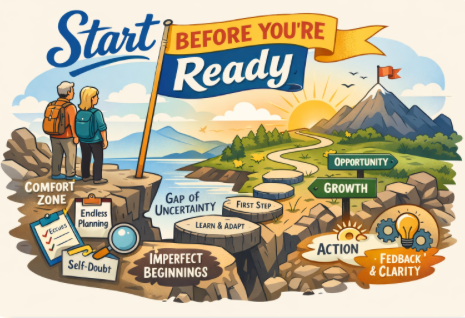
But more often than we admit, it is fear dressed up as preparation. We tell ourselves we are being cautious. That we are just being thorough. That we owe it to ourselves to get things right before we begin.
Yet if we are honest, what we are really waiting for is emotional certainty. The absence of doubt. The removal of risk.
That moment almost never arrives.
I have watched people delay investing because they want to understand markets perfectly. Delay retirement planning because projections still feel fuzzy. Delay career pivots because they want one more credential. Delay creative projects because the vision is not fully formed. In every case, the intention is good. The outcome is stagnation.
Catching Myself in the Same Trap
A few months ago, I realised I was doing exactly the same thing. I had been hesitating about moving Retirement Guru to the next level by launching a proper website.
Not because I lacked clarity on purpose.
Not because there was no audience.
Not because the ideas were untested.
But because I kept telling myself I was not ready yet.
The positioning could be sharper.
The content ecosystem could be tighter.
The monetisation pathways could be clearer.
All true.
And all excuses.
Each reason sounded rational on its own. Together, they formed a perfect justification for inaction. What I was really saying was this. I did not want to put something into the world that felt incomplete. I did not want to risk being misunderstood. I did not want to commit before I had certainty.
In other words, I wanted readiness before movement.
The Uncomfortable Truth About Readiness
Here is the truth many of us avoid.
We are almost never fully ready for the things that matter. Readiness is not a state we arrive at. It is a by-product of movement. You do not become ready and then act. You act, and readiness catches up.
Think about the major transitions in your life. Your first serious job. Parenthood. Leadership roles. Even retirement itself. How many of those did you truly feel ready for at the beginning?
Most of us stepped into them with partial information, imperfect confidence, and a quiet sense of uncertainty. And yet, we learned. We adapted. We grew.
Action came first. Readiness followed.
Why Waiting Feels Safe but Is Not
Waiting feels safe because it avoids immediate discomfort. There is no risk of failure if you never start. No exposure to criticism if you keep refining in private. No vulnerability if you stay in planning mode.
But the cost of waiting is rarely visible upfront. It compounds quietly. Confidence erodes as months turn into years. Energy dissipates as momentum stalls. Opportunities drift as timing windows close.
What makes this particularly dangerous in retirement planning is that time is the one variable you cannot replace. You can adjust spending. You can redesign income. You can simplify lifestyle.
But you cannot reclaim years lost to hesitation.
Action Creates a Different Kind of Clarity
One of the most misunderstood ideas about clarity is this.
Clarity does not come from thinking harder. It comes from committing sooner. When something lives only in your head, it remains abstract. Hypothetical. Safe. The moment you put it into the world, reality responds.
Feedback sharpens thinking.
Constraints force focus.
Real conversations replace imagined fears.
As a communications practitioner and facilitator, I see this all the time. Discussions are vague until there is something concrete to respond to. Once there is a draft, a prototype, or a decision, conversations become clearer almost immediately.
Momentum changes the quality of our thinking.
The same applies to life transitions. Career pivots. Retirement redesigns. Creative projects.
You cannot plan your way into certainty. You have to act your way into it.
Retirement Is Especially Vulnerable to Overthinking
Retirement magnifies this problem. Because it feels irreversible, many people treat it as a decision that must be perfectly optimised before they move. They want exact numbers. Exact timelines. Exact emotional certainty.
So they wait.
They wait for the perfect financial cushion.
They wait for complete clarity on purpose.
They wait for permission from an invisible authority.
In the meantime, life continues.
What often goes unnoticed is that retirement itself is not a single decision. It is a series of small experiments.
Trying a new rhythm.
Testing a different income mix.
Exploring new identities beyond work.
Each experiment teaches you something no spreadsheet can.
The Myth of the Perfect Moment
There is rarely a perfect moment. There is only a moment that asks whether you are willing to begin imperfectly. This applies whether you are launching a blog, redesigning your retirement lifestyle, starting a side income, or finally having the conversation you have been avoiding.
The moment never arrives fully formed. You create it by stepping into it. And yes, you will make mistakes. You will revise assumptions. You will cringe at earlier versions of your thinking.
That is not failure. That is progress doing its job.
Progress Is More Forgiving Than Perfection
One of the quiet gifts of progress is that it is forgiving. You do not have to get everything right the first time. You only need to be willing to adjust. Those who move early gain something planners often miss. Real data. They see what resonates. They learn what drains energy. They discover what matters more than they expected. Progress rewards those who start and refine. Perfection rewards no one, because it never shows up.
What This Means for You
If you are waiting to feel ready, consider asking yourself a different question: “Is the direction clear enough?”
You do not need full certainty. You need sufficient alignment. If your intent is honest, your direction is sound, and your values are clear, that is enough to begin. The rest will meet you in motion. This does not mean acting recklessly. It means recognising when preparation has quietly turned into avoidance.
Start smaller if needed. Start imperfectly. Start quietly.
But start.
A Final Reflection
Looking back, the moments that shaped my life most were not the ones where I felt ready. They were the ones where I acted despite uncertainty.
Retirement is no different.
You do not need to have everything figured out.
You do not need to feel confident every step of the way.
You do not need permission.
You need to begin.
Not when you feel ready.
But when the direction is clear enough and the intent is honest.
The rest has a way of catching up.
If you enjoyed this piece, follow me for more reflections from the Retiree Wisdom series on retirement redesign, cash flow thinking, and intentional living. If you are navigating a transition yourself, share what you are waiting to feel ready for. Sometimes naming it is the first step forward. And, if what I shared changed the way you see life, consider tipping me a cup coffee via Stripe — it keeps me writing!


 Users Today : 0
 Users Yesterday : 1
 Users Last 7 days : 2
 Users Last 30 days : 27
 Users This Month : 14
 Users This Year : 361
 Total Users : 362
 Views Today :
  Views Yesterday : 2
 Views Last 7 days : 8
 Views Last 30 days : 55
 Views This Month : 30
 Views This Year : 935
 Total views : 936
 Who's Online : 0