How the Income Pillar of My HIPE Framework Evolved in 2025
If you are building a retirement plan and quietly wondering whether your income will really be enough, this reflection may help.
As 2025 comes to a close, I find myself looking back at the four pillars of my HIPE framework. Health. Income. Purpose. Experiences.
Each matters. But if I am honest, Income was the pillar that evolved the most this year.
Not because I chased higher returns.
Not because markets were unusually generous.
But because I finally reframed how I thought about retirement income altogether.
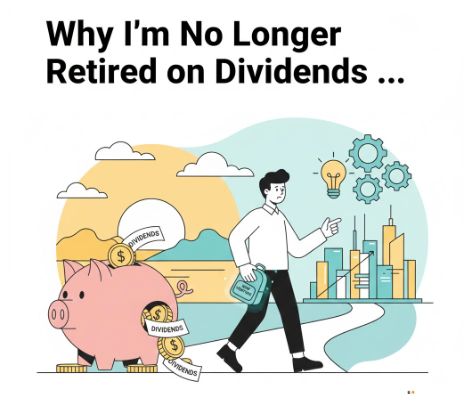
At the start of the year, I believed I was retired on dividends. By the end of the year, I realised something more precise and more powerful. I am retired on dividend-option income. That shift did not happen overnight. It came from reflection, learning, and a willingness to admit that what once worked well was no longer sufficient on its own.
The Original Role of Income in HIPE
When I first articulated HIPE, the Income pillar had a clear job.
Income exists to:
- fund daily living without anxiety
- support Health choices without compromise
- enable Experiences without guilt
- create space for Purpose work without desperation
Income was never about maximisation. It was about stability and dignity. For years, dividend investing fulfilled that role beautifully.
Dividends were predictable.
They arrived without effort.
They felt earned rather than extracted.
But by early 2025, I noticed a subtle tension. The income was stable, but it was also rigid. Predictable, but slow to adapt. Comforting, but capped. That tension became the catalyst for change.
The Dividend Comfort Trap
Dividends are often presented as the endgame of investing.
Build a portfolio.
Collect distributions.
Live happily ever after.
The reality is more nuanced. Dividend income depends on:
- corporate payout decisions
- sector cycles
- valuation environments
- interest rate regimes
In flat or volatile markets, dividend growth stalls. In high-rate environments, yields get compressed. And in retirement, capital injections stop. I remember reviewing my numbers one quiet evening and thinking “This works. But it works narrowly.”
That realisation did not create panic. It created curiosity. And curiosity is often the beginning of better financial literacy.
2025 as the Year of Income Re-Engineering
I now see 2025 as the year I stopped receiving income and started designing it. This is where the Income pillar matured.
Instead of asking: “How much yield does my portfolio generate?” I began asking: “How many ways can this portfolio pay me responsibly?” That question led me to revisit something I had avoided for years — Options.
Not as speculation.
Not as leverage.
But as contracts that could complement dividends rather than replace them.
Options as an Extension of Income Literacy
I deliberately limited myself to two strategies:
- selling cash-secured puts
- selling covered calls
No margin.
No leverage.
No complexity.
What struck me was how naturally these strategies aligned with my existing mindset.
Cash-secured puts paid me to wait patiently for good entry prices.
Covered calls paid me to commit to sensible exit prices.
I was already doing both mentally. Options simply paid me for stating those intentions explicitly. That was the insight. Options are not magic. They are monetised discipline.
From Dividend Income to Dividend-Option Income
As the year progressed, the numbers told a quiet but undeniable story.
The same capital base now generated:
- dividends as a foundational layer
- option premiums as a consistent overlay
Income became:
- more frequent
- more flexible
- more responsive to market conditions
By year-end, my monthly cash flow had increased by roughly 200% compared to dividends alone. Not because I took more risk. But because I activated more dimensions of income.
This is when I stopped describing my retirement income as “dividend-based.” That label was no longer accurate. I was retired on dividend-option income.
Why This Shift Strengthened the HIPE Framework
The Income pillar does not exist in isolation. Once income became smoother and more predictable, everything else improved.
Health decisions felt easier.
Purpose work felt lighter.
Experiences felt more spontaneous.
I no longer needed to ask: “Can I afford this?” The question became:
“Do I want this?” That is the difference between income sufficiency and income confidence.
The Emotional Dividend of Income Design
There is an emotional layer to income that spreadsheets do not capture. Before, income depended on:
- payout schedules
- market cycles
- external decisions
Now, income depends largely on:
- my rules
- my risk limits
- my consistency
That shift created calm. Markets could be choppy. Headlines could be dramatic. Cash flow still arrived. That is a quiet kind of freedom that is difficult to explain until you experience it.
Financial Literacy as the Real Return
Looking back, the most important return in 2025 was not financial.
It was literacy.
Understanding how options work forced me to:
- think probabilistically
- define acceptable outcomes
- respect risk explicitly
This made me a better investor, not a riskier one.
Too many people stop learning once they reach basic competence.
They outsource the rest. But retirement is not forgiving to complacency. The Income pillar of HIPE demands ongoing education because income problems rarely announce themselves early.
What I Wish I Had Known Earlier
If I could speak to my younger self, I would say this.
Dividend investing is a strong foundation.
But foundations are meant to support structures, not replace them.
Options, used conservatively, are not about beating the market.
They are about shaping cash flow.
Income is not something you wait for.
It is something you design.
That realisation alone would have accelerated my confidence years earlier.
Practical Guardrails I Follow
For those curious, these are the principles that kept 2025 calm rather than stressful.
- Only sell options on assets I already want to own
- Keep position sizes intentionally boring
- Never chase yield with leverage
- Treat premiums as income, not capital gains
- Optimise for repeatability, not excitement
These guardrails are why this approach strengthened, rather than destabilised, the Income pillar.
Income as Dignity, Not Domination
One important clarification. This is not about extracting maximum dollars from the market. It is about maintaining dignity in retirement.
Income that is too fragile creates anxiety.
Income that is too aggressive creates fear.
The goal of HIPE is always balance.
In 2025, the Income pillar moved closer to that ideal.
Closing Reflection on the Income Pillar
As I close the year, I no longer measure success by net worth alone.
I measure it by:
- monthly cash flow reliability
- emotional calm
- optionality in how I spend my time
Dividends gave me stability.
Options gave me flexibility.
Together, they transformed my retirement income from passive to intentional.
That is the true evolution of the Income pillar in 2025.
If this reflection resonated, follow me for more insights on retirement design, financial literacy, and building income with intention. If you are on your own Income journey, share where you are. Dividend-focused. Exploring options. Or simply learning. Conversations like these make us all better prepared.
And, if this article taught you something, consider tipping me a cup of coffee — it keeps me writing and caffeinated! Buy me a coffee via Stripe


 Users Today : 0
 Users Yesterday : 1
 Users Last 7 days : 2
 Users Last 30 days : 27
 Users This Month : 14
 Users This Year : 361
 Total Users : 362
 Views Today :
  Views Yesterday : 2
 Views Last 7 days : 8
 Views Last 30 days : 55
 Views This Month : 30
 Views This Year : 935
 Total views : 936
 Who's Online : 0